When in doubt about the specification of the ambient density values it is reasonable to first simplify as much as possible.
The sensitivity of a given assumption can be explored in subsequent CORMIX simulations.
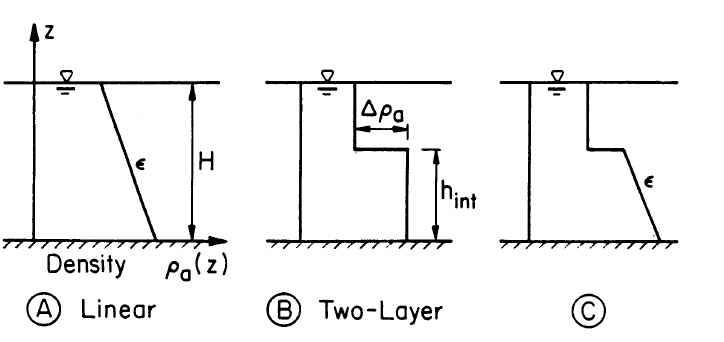
For instance, the CorSens sensitivity analysis tool can automatically create cases with variation of
Type A linear ambient density profiles.
Furthermore, if CORMIX flow classification indicates indeed a flow configuration (flow class)
with near-field flow behavior which is stable, additional
studies with the post-processor option CorJet can be performed to investigate any arbitrary density distribution.
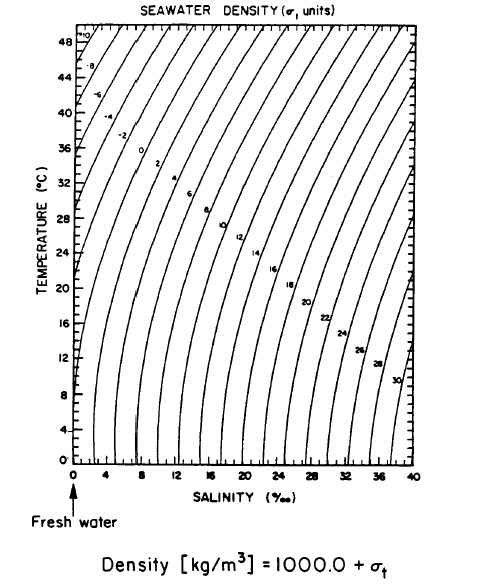
After selecting the stratification approximation to be used, the user then enters all appropriate density (or temperature) values
and pycnocline heights (HINT) to fully specify the profiles. The pycnocline is defined as zone or level of strong density change that
separates the upper and lower layers of the water column. The program checks the density specification to insure that stable
ambient stratification exists (i.e. the density at higher elevations must not exceed that at lower elevations).
Note that a dynamically correct approximation of the actual density distribution should keep a balance between over-and
under-estimation of the actual data similar to a best-fit in regression analysis. If simulation results indicate internal plume trapping,
then it is desirable to test --through repeated use of CORMIX using CorSens-- different
approximations (i.e. with different stratification types and/or parameter values) in order to evaluate the sensitivity
of the resulting model predictions.