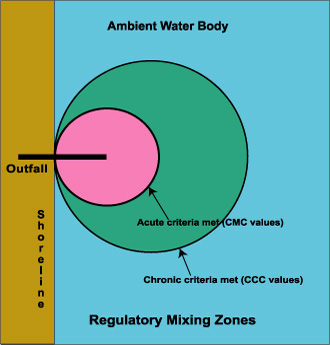
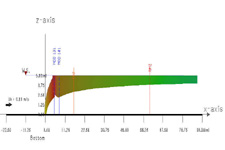
From the 1984 USEPA "Water Quality Handbook" (bold mine), the (regulatory) mixing zone is
defined as an "allocated impact zone" where numeric water quality criteria may be exceeded as long as acutely toxic
conditions are prevent. A (regulatory) mixing zone can be thought of as a limited area or volume where the initial
dilution of a discharge occurs. Water quality criteria apply at the boundary of the (regulatory) mixing zone, not
within the mixing zone itself.
Furthermore, "the area or volume of an individual (regulatory) mixing zone or group of
(regulatory) mixing zones be limited to an area or volume as small as practicable that with not interfere
with the designated uses or the established community of aquatic life in the segment for which the uses are designated," and the
shape be "a simple configuration that is easy to locate in the body of water and avoids impingement on biologically
important areas", and the "shore hugging plumes should be avoided."
Within the (regulatory) mixing zone, USEPA requires "any (regulatory) mixing zone should be
free from point or nonpoint source related:
- Material in concentrations that will cause acute toxicity to aquatic life;
- Materials in concentrations that settle to form objectionable deposits;
- Floating debris, oil scum and other matter in concentrations that form nuisances;
- Substances in concentrations that produce objectionable color, odor, taste or turbidity;
- Substances in concentrations which produce undesirable aquatic life or result in a dominance of nuisance species.
USEPA maintains two water quality criteria for allowable concentrations of toxic discharges:
CMC is spatially more restrictive than the CCC.
The CCC is often treated like a water quality standard, it must be met at the edge of the same
regulatory mixing zone specified for conventional or toxic pollutants.
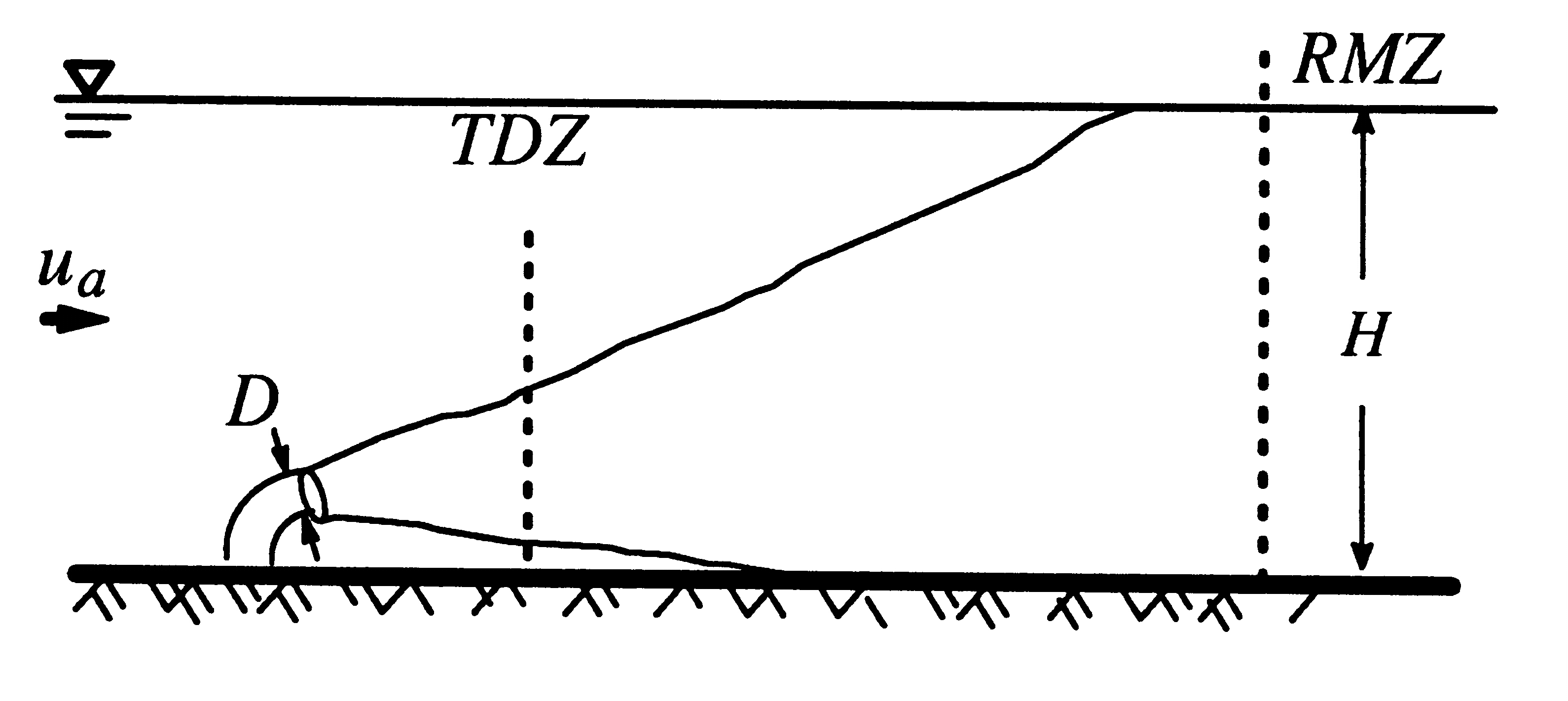
Toxic Dilution Zone (TDZ) Requirements
USEPA allows a toxic dilution zone within the regulatory mixing zone, but it must comply with one
of four of the following criteria:
- Meet the CMC within the discharge pipe.
- Exit velocity must exceed 3 m/s (10 ft/s).
- Geometric Restrictions.
- Show that a drifting organism will be exposed less than 1 hour to CMC no more than once in 3 years.
Geometric Restrictions within the Toxic Dilution Zone (TDZ)
- The CMC must be met with 10% of the distance from the edge of the outfall structure to the edge of the regulatory mixing zone in any spatial direction.
- The CMC must be met with a distance of 50 times the discharge length scale in any spatial direction. The discharge length scale (LQ) is defined as the square-root of the cross-sectional area of any discharge outlet (LQ ~ D).
- The CMC must be met within a distance of 5 times the local water depth in any horizontal direction.