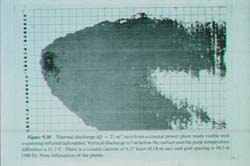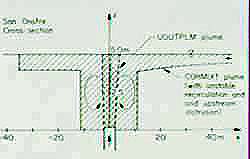

A common problem in mixing zone analysis is disposal of heated wastewater from industrial cooling processes. These sources can be quite large (perhaps 10 m**3/s for electric generation plants) and are generally heated to a few degrees above ambient. Thermal efficiency of heat exchangers suffers greatly if the cooling water intake is contaminated by the heated discharge in the near-field or far-field. It is therefore essential in outfall design to predict plume behavior. Particular attention should be paid to surface density current and buoyant upstream spreading flow behavior.
Recently, new interest has arisen in the application of Lake Source Cooling in temperate locations. With this technology, cool lake water is withdrawn from stratified lakes to provide cool water demand for air-conditioning. Lightly heated water is discharged back into the lake.
l.jpg)